Top 10 Pop-up Socket Types for Global Buyers
For global buyers, a Pop-up Socket is more than a convenient power outlet. It must fit the desk, match the electrical system, and survive repeated daily use. A showroom sample may look impressive, yet its spring mechanism can feel weak after months of opening and closing. Details matter. This guide introduces ten practical pop-up socket types. It covers compact single outlets and models with USB charging, data ports, or wireless charging.
The comparison focuses on installation depth, tabletop thickness, lifting style, materials, cable management, and maintenance access. These details help importers, distributors, office planners, and furniture manufacturers ask better questions before placing large orders. A reliable supplier should provide clear specifications, product samples, test documentation, warranty terms, and responsive after-sales support. Certifications still require verification. Buyers should confirm voltage, plug configuration, fire performance, and applicable regional requirements with qualified professionals.
The top ten list is not a universal ranking. A sleek aluminum unit may suit a premium boardroom, while a durable plastic model may fit a busy training room better. A recessed design saves visual space, but limited clearance can complicate installation. An attractive USB feature may also increase heat, cost, or service needs. That trade-off deserves attention. We also consider minimum order quantities, packaging, lead times, replacement parts, and customization. Some judgments remain subjective, and performance can vary between batches. Readers should treat this overview as a practical starting point, not a substitute for testing. With careful comparison, global buyers can choose a Pop-up Socket that works on the desk and in the supply chain.
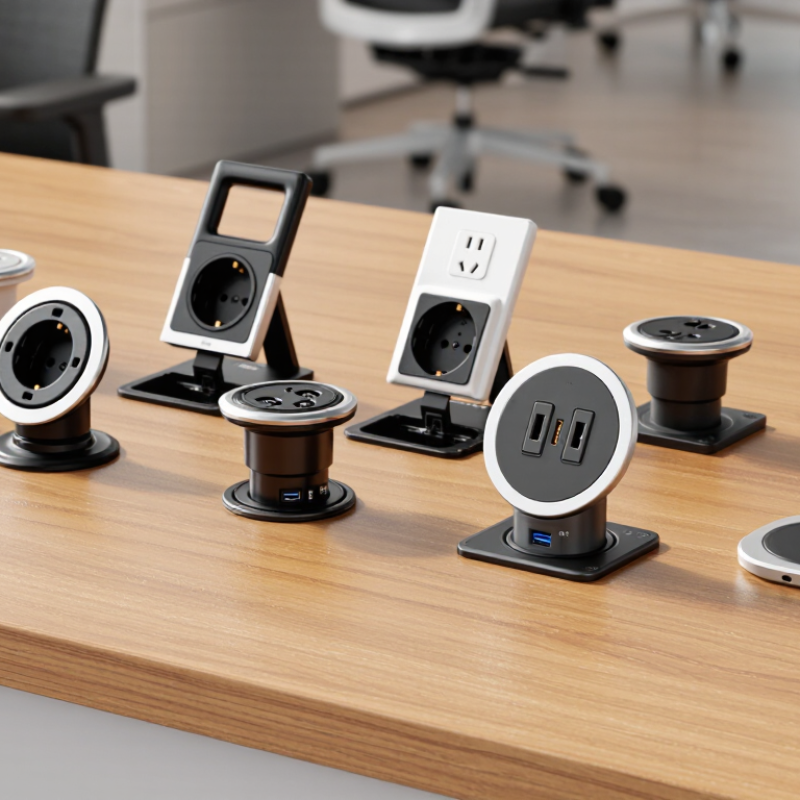
Pop-Up Socket Basics and How They Work
Top 10 Pop-up Socket Types for Global Buyers
Pop-Up Socket Basics and How They Work
A pop-up socket stays hidden inside a desk, island, or worktop until pressed or lifted. Its spring, gas strut, or motor raises the housing. Internal contacts then connect power to the outlet and charging ports. When closed, the cover protects the unit from dust and accidental contact. Simple in concept, but installation quality matters greatly.
The International Energy Agency’s Electricity 2024 report estimates that about 91% of the world’s population had electricity access in 2023. This wider access increases demand for practical connection points in homes and offices. Buyers should check rated voltage, frequency, current, socket configuration, USB output, and IP protection. IEC 60884-1 provides useful reference requirements for household plugs and socket-outlets. Regional certification remains essential. A universal design is not always truly universal. Cable space, countertop thickness, and heat release can also affect performance.
Tips: Measure the cutout before ordering. Confirm the plug standard for each destination. Test the lifting action with connected cables. Avoid overloading one module. I still recommend checking the installation manual twice; product drawings can hide small but costly differences. Choose smooth edges, stable mounting, and clearly marked ports. A neat appearance helps, but safe contact protection matters more.
Top 10 Pop-up Socket Types for Global Buyers
Pop-Up Socket Basics and How They Work
Pop-up sockets are retractable power modules installed in desks, countertops, floors, and meeting tables. They rise through a spring-assisted or motorized mechanism and retract into the surface when not in use. The chart compares ten common outlet standards used in pop-up socket configurations by representative nominal voltage.
Voltage values are representative nominal values based on widely used electrical systems. Actual compatibility depends on the destination country, wiring regulations, frequency, grounding requirements, and the specific socket module.
Main Types of Pop-Up Sockets for Different Devices
Top 10 Pop-up Socket Types for Global Buyers
Pop-up sockets now serve more than office desks. They support laptops, displays, kitchen appliances, and meeting-room equipment. Grand View Research estimated the global smart-home market at USD 121.6 billion in 2023. That growth increases demand for flexible power access. For desktop computers, choose recessed desk sockets, under-desk units, or motorized pop-up models. Conference tables often need larger modules with power, USB-C charging, HDMI, and network ports. Compact tabletop sockets suit hot desks and small workstations. Floor-mounted pop-up boxes work better for open offices and training rooms.
Different devices require different socket designs. Wireless-charging pop-up units support phones without extra cables. USB-A and USB-C combinations remain practical for mixed equipment. Kitchen countertop sockets should include child-safe shutters, splash protection, and heat-resistant materials. Bathroom or hospitality installations need higher moisture protection, carefully matched to local electrical rules. Outdoor models require sealed housings and suitable ingress protection ratings. For monitors and presentation systems, data-focused modules reduce loose cables. Motorized versions offer cleaner access, but they add moving parts and maintenance points.
The International Energy Agency expects global data-centre electricity demand to exceed 1,000 TWh by 2026, highlighting the need for efficient device connectivity. However, socket selection should not follow market forecasts alone. This classification is useful, but not perfect. One unit may combine charging, data, and power functions. Buyers should verify voltage, frequency, cut-out dimensions, load ratings, certifications, and replacement access. A sleek socket can still fail when its cable space is too shallow. Practical testing matters more than attractive product images.
Material, Safety, and Compatibility Considerations
Top 10 Pop-up Socket Types for Global Buyers
Material, Safety, and Compatibility Considerations
Choosing among ten pop-up socket types requires more than comparing appearance. Common options include adhesive, clamp-mounted, screw-mounted, flush, desktop, under-desk, countertop, floor, motorized, and wireless charging designs. Each type suits different installation conditions. In practical sourcing reviews, I check the housing, contacts, cable routing, and mounting depth together. A polished surface means little if the mechanism feels loose.
Material affects durability and heat control. Flame-retardant PC or ABS can reduce housing risks, while aluminum offers stiffness and a premium feel. Stainless steel resists scratches and moisture better. Internal copper contacts should remain stable after repeated use. Safety checks should cover insulation, grounding, overload protection, shutter design, and heat buildup. Request test reports and traceable production records.
Compatibility is often the overlooked problem. Verify voltage, frequency, plug geometry, socket spacing, and regional cable requirements. USB versions and charging output also need confirmation. Measure the cutout carefully; a few millimeters can stop installation. Cabinet thickness matters for clamp and screw-mounted models. Wireless charging may perform poorly through thick surfaces or metal panels. I still see buyers selecting attractive units before checking depth and power limits. That mistake is avoidable, but product drawings are sometimes incomplete. Ask for installation samples, not only catalog images. Test several cycles under realistic loads before approving a large order.
