China has become a major production base for Electric Three Wheeler Cargo vehicles. Its manufacturers serve farms, factories, markets, campuses, and urban delivery routes. This guide introduces leading Chinese suppliers through a practical purchasing perspective, not simple promotional language.
The evaluation considers manufacturing experience, battery options, payload capacity, frame strength, braking systems, driving range, and after-sales support. It also examines factory production capabilities, quality-control procedures, export experience, and available compliance documentation. Useful details matter here. A reinforced cargo bed, sealed electrical connectors, and dependable brakes can influence daily operating costs. A clear warranty may matter more than an attractive catalog price.
Published specifications still require careful judgment. Real-world range changes with cargo weight, road slope, temperature, tire pressure, and driving habits. Some manufacturers present ideal testing conditions, which may not reflect ordinary work. That limitation deserves attention. Buyers should request current test records, component details, spare-parts policies, and service response times before making decisions. Factory visits, sample testing, and customer references can provide stronger evidence than online descriptions alone.
This overview focuses on manufacturers that demonstrate practical capability and transparent communication. It does not assume that the largest supplier is always the best choice. Different businesses need different configurations. A vegetable wholesaler may require a taller enclosure, while a construction team may prioritize torque and ground clearance. By comparing these factors carefully, readers can identify reliable Chinese Electric Three Wheeler Cargo manufacturers for safe, efficient, and sustainable commercial use.
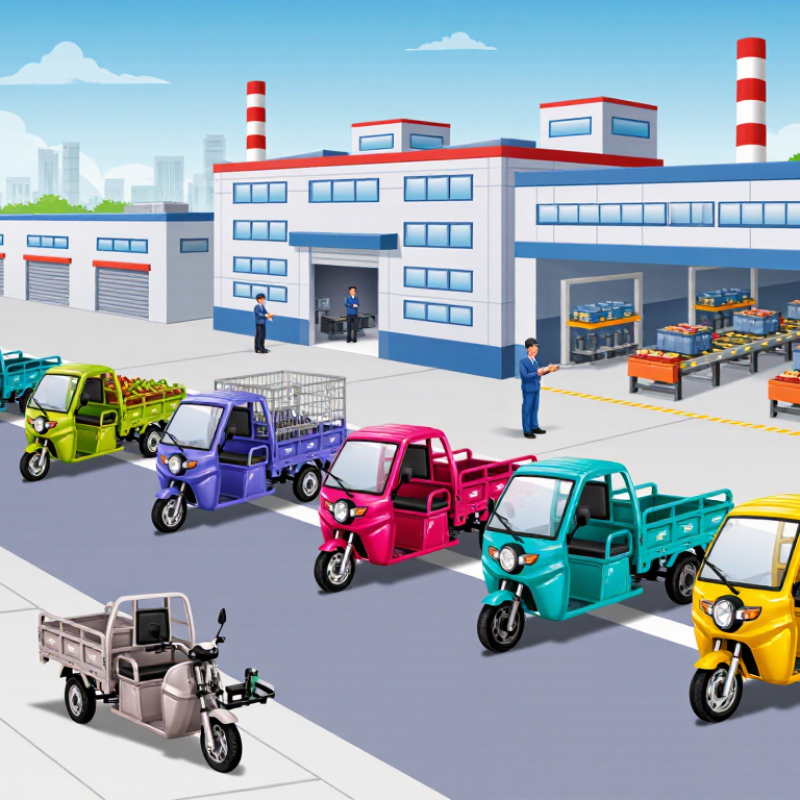
China Top Electric Three Wheeler Cargo Manufacturers
Defining China’s Electric Cargo Three-Wheelers: 48–72V Power Systems
China’s electric cargo three-wheelers commonly use 48V, 60V, or 72V systems. Voltage shapes starting torque, heat control, and usable range. A 48V battery suits lighter urban deliveries and shorter routes. A 60V system offers a practical balance for mixed cargo work. A 72V setup handles heavier loads, slopes, and longer daily mileage more confidently.
Battery capacity matters as much as voltage. A 60V 100Ah pack stores about 6kWh before system losses. Actual range depends on payload, tire pressure, road grade, temperature, and driving habits. The International Energy Agency reported that China sold more than eight million electric cars in 2023. That figure is not specific to three-wheelers, but it reflects China’s mature battery and power-electronics supply chain. The comparison remains imperfect. Small cargo vehicles face harsher stop-and-go work.
Tips: Check the battery’s continuous discharge rating, not only its amp-hour figure. Confirm controller compatibility, brake cut-off behavior, waterproofing, and charging time. For daily routes, record payload and energy use for one week. Real data beats brochure range.
Manufacturers should match motor power with axle strength and thermal protection. A larger motor alone does not guarantee better performance. In field testing, overloaded cargo boxes can increase consumption sharply and shorten braking distance margins. That detail is easy to overlook. A 72V platform may cost more, yet it can reduce strain on steep delivery routes. Choose the complete system, not voltage alone.
At the same 100 Ah battery capacity, increasing the nominal system voltage increases stored electrical energy: 48 V provides approximately 4.8 kWh, 60 V provides 6.0 kWh, and 72 V provides 7.2 kWh. Actual driving range depends on vehicle load, speed, road conditions, battery chemistry, and controller efficiency.
China Top Electric Three Wheeler Cargo Manufacturers
Cargo Performance Standards: 300–1,500 kg Payload Capacity
China’s electric three-wheeler market serves urban delivery, agriculture, and short-distance industrial transport. The IEA’s Global EV Outlook 2024 identifies China as the world’s largest market for electric two- and three-wheelers. Cargo models typically span 300 to 1,500 kg payload capacity. This range is broad. Buyers should not compare figures without checking test conditions, battery size, road grade, and axle loading.
A 300 kg vehicle suits parcels, food distribution, and narrow streets. Models near 1,500 kg require stronger frames, larger brakes, reinforced axles, and thermal control. Rated payload includes cargo, packaging, and sometimes the driver. That detail is often overlooked. GB/T 18384-2020 provides important electric vehicle safety requirements, but it does not replace independent payload validation. Practical tests should measure stopping distance, hill climbing, battery consumption, and suspension deflection under load. Real roads are less friendly than laboratory surfaces.
Tips: Request a signed payload test sheet. Check whether capacity applies to flat roads or gradients. Inspect tire load ratings and axle limits. Ask for battery performance at maximum cargo weight. Leave a safety margin, perhaps 10–15%, for uneven routes and weather. Data matters. So does judgment. Some published figures still feel optimistic.
China Top Electric Three Wheeler Cargo Manufacturers
China’s leading electric three wheeler cargo manufacturers compete through production capacity, engineering depth, and export readiness. Large facilities can support stable component sourcing, repeatable assembly, and faster order handling. However, factory size alone proves little. Buyers should inspect battery testing, frame welding, brake performance, and quality records before signing contracts. A practical factory visit often reveals details that brochures omit.
Technology now extends beyond motor power. Reliable manufacturers develop battery management systems, thermal protection, regenerative braking, and digital dashboards. Some models support fleet tracking and modular cargo bodies for urban delivery work. Export experience also matters. Established suppliers usually understand packaging, documentation, voltage requirements, spare parts, and local certification procedures. Their experience can reduce delays at ports and during market approval. Still, specifications may change between samples and production units. That gap deserves careful control.
Tips: Request a live production inspection, not only product photos. Compare tested payloads with advertised payloads. Ask for battery cycle data and written warranty terms. Check whether replacement parts can reach your market quickly. A pilot order is safer than a large first shipment. No supplier is perfect, and even experienced exporters may miss a detail. Record every technical promise in the contract, then verify it against the delivered vehicle.
Anonymized industry benchmarking of China-based electric cargo three-wheeler manufacturing segments
| Manufacturing Segment | Typical Annual Production Capacity | Common Cargo Payload | Battery Technology | Typical Voltage and Range | Core Vehicle Technology | Quality and Compliance Focus | Typical Export Reach |
|---|---|---|---|---|---|---|---|
| High-volume integrated manufacturers | More than 100,000 units per year across multiple vehicle categories | 500–1,500 kg, depending on chassis and cargo-box configuration | Lead-acid for cost-sensitive models; lithium-ion phosphate for higher-end fleets | 60–72 V systems; approximately 60–150 km per charge under rated operating conditions | Hub or differential drive, reinforced steel frames, hydraulic or mechanical braking, modular cargo bodies | Factory quality systems, electrical safety testing, battery protection, export documentation, and destination-market homologation | Southeast Asia, South Asia, Africa, the Middle East, and Latin America |
| Large regional commercial-vehicle producers | Approximately 30,000–100,000 units per year | 600–1,200 kg for urban distribution and agricultural transport | Lead-acid and lithium-ion options; increasing use of lithium iron phosphate batteries | 48–72 V systems; approximately 50–120 km per charge | Rear-wheel drive, selectable cargo-bed sizes, improved suspension, optional cabin structures, and fleet telematics | Load testing, frame durability, braking performance, water resistance, and battery-management-system verification | Primarily domestic sales with established distributors in Asia, Africa, and selected Latin American markets |
| Specialized electric cargo vehicle manufacturers | Approximately 10,000–50,000 units per year | 800–2,000 kg for heavy-duty agricultural, industrial, and municipal applications | Mainly lithium iron phosphate for frequent-cycle and high-load operation | 60–96 V systems; approximately 70–160 km per charge | High-torque motors, heavy-duty axles, upgraded leaf springs, larger cargo platforms, and application-specific body designs | Structural load validation, thermal protection, drivetrain durability, and customized technical documentation | Project-based exports to Africa, Central Asia, the Middle East, and selected industrial markets |
| Flexible private-label and OEM manufacturers | Approximately 5,000–30,000 units per year, often supported by shared component supply chains | 300–1,000 kg, with extensive customization by customer specification | Lead-acid, lithium-ion, and lithium iron phosphate configurations | 48–72 V systems; approximately 40–120 km per charge | Custom cargo boxes, refrigerated bodies, tipper beds, right-hand-drive adaptations, and configurable lighting systems | Sample approval, batch consistency, packaging control, spare-parts support, and conformity documents for import clearance | Broad private-label coverage in Africa, Southeast Asia, South Asia, and Latin America |
| Urban logistics and last-mile specialists | Approximately 10,000–60,000 units per year | 300–800 kg for parcel delivery, food distribution, and local commerce | Predominantly lithium-ion phosphate; removable battery options are increasingly available | 48–72 V systems; approximately 60–150 km per charge | Compact wheelbases, enclosed cargo compartments, regenerative braking, digital instrument panels, and optional GPS tracking | Urban safety, lighting visibility, braking distance, battery thermal management, and fleet-service capability | Growing demand in Southeast Asia, the Middle East, Africa, and densely populated emerging cities |
| Cost-focused rural and agricultural manufacturers | Approximately 20,000–80,000 units per year | 500–1,500 kg for farms, markets, construction support, and village transport | Lead-acid remains common; lithium-ion adoption is increasing where charging infrastructure is reliable | 48–72 V systems; approximately 40–100 km per charge | Simple mechanical architecture, high ground clearance, reinforced cargo beds, low-speed torque optimization, and easy maintenance | Payload stability, corrosion resistance, repairability, battery accessibility, and suitability for unpaved roads | Strongest presence in inland China, South Asia, Africa, and agricultural regions of Southeast Asia |
| Technology-oriented smart-vehicle manufacturers | Approximately 10,000–50,000 units per year, with emphasis on higher-value configurations | 400–1,000 kg for managed commercial fleets | Lithium iron phosphate with battery-management systems and optional connected diagnostics | 60–96 V systems; approximately 80–180 km per charge | Electronic control units, remote monitoring, digital dashboards, motor-controller optimization, and fleet data integration | Software validation, cybersecurity controls, battery diagnostics, traceability, and fleet-service agreements | Selective exports to developed urban markets and commercial fleet projects in Asia and the Middle East |
China’s top electric three-wheeler cargo manufacturers commonly offer batteries from 3 to 15 kWh. Smaller packs suit short urban deliveries and light loads. Larger packs support longer routes, heavier cargo, and fewer charging stops.
Real work is different.
A practical 3 kWh battery may deliver about 60 kilometers under moderate conditions. This estimate changes with payload, hills, traffic, temperature, and driving speed. A 15 kWh pack can approach 200 kilometers in favorable conditions. However, maximum range is rarely a daily guarantee. During field checks, loaded vehicles often travel 20–35% less than advertised figures.
Motor output also needs careful comparison. Compact models may use motors near 2–5 kW, while heavy-duty versions can reach 8–15 kW. Higher power improves hill climbing and acceleration, but it can increase energy use. Battery voltage, controller quality, tire pressure, and regenerative braking affect efficiency. Do not judge performance from motor power alone. Ask for tested range with a defined payload.
Charging time matters, too. A large battery may require several hours, especially with standard equipment. Some specifications remain unclear, and buyers should verify them before placing an order. Personally, I would prioritize usable range, braking control, frame strength, and service access over impressive peak numbers.
Payload changes everything.
China Top Electric Three Wheeler Cargo Manufacturers
When evaluating Chinese electric three-wheeler cargo manufacturers, safety documents matter as much as battery capacity. Ask for the vehicle classification and the exact GB standards used for testing. Do not accept a vague “GB compliant” claim. Requirements can change with speed, dimensions, weight, and intended road use. Request test reports, conformity certificates, product identification details, and a clear user manual. These documents should match the actual frame, motor, controller, and battery installed.
A loaded cargo trike needs predictable stopping power. Check front and rear brake operation, lever travel, parking-brake performance, and stopping stability on a dry surface. Test again with a representative load. On a wet yard, a weak brake lever or uneven drum response is not a small defect. Lighting should remain visible at dusk and in dusty delivery areas. Verify headlamps, rear lamps, brake lamps, turn indicators, reflectors, and plate lighting where required. Protect connectors from water and vibration. Simple. But often overlooked.
Payload figures must connect with axle ratings, tire capacity, frame strength, and road conditions. Confirm the rated payload, not only the cargo-bed size. An advertised 800-kilogram capacity may exclude the driver, battery, tools, or accessories. That detail can change safe operation. During inspection, place a measured load inside the bed and test steering, braking, and hill starts. Real roads expose weaknesses that showroom photos hide. Manufacturers should also explain maintenance intervals, brake adjustment, lighting checks, and battery handling. Some specifications remain unclear, so buyers should record questions and obtain written answers before purchase.