Skip to content

Why Are Robotic Gears Essential for Automation?

Automation often looks effortless from the outside. A robot grips a metal part, turns it, and places it precisely on a moving conveyor. Hidden inside that motion, a Robotic Gear transfers torque and helps control speed, direction, and positioning. Its teeth must mesh reliably, even as loads change during long production shifts. Small amounts of backlash or wear can become visible as vibration, noise, or missed placements. That matters.

Roboticist Rodney Brooks wrote, “The world is its own best model.” The line reflects a broader robotics principle: machines must work with real conditions, not ideal assumptions. It is not a statement about gears specifically, but it helps frame why their design deserves close attention. A useful introduction should explore how gear ratios, materials, lubrication, and mounting affect automation performance. It should also compare common options, such as planetary and strain-wave gears, without suggesting one fits every robot. A compact joint may need high torque in limited space; a fast pick-and-place arm may prioritize low inertia and smooth motion. Trade-offs remain.

Even a carefully selected gear can wear. Maintenance schedules, operating temperatures, and load cycles matter too. These details are easy to overlook when discussing automation only through software or sensors. A more grounded view asks what happens after thousands of repeated movements—and whether the gear still delivers the accuracy the task requires.
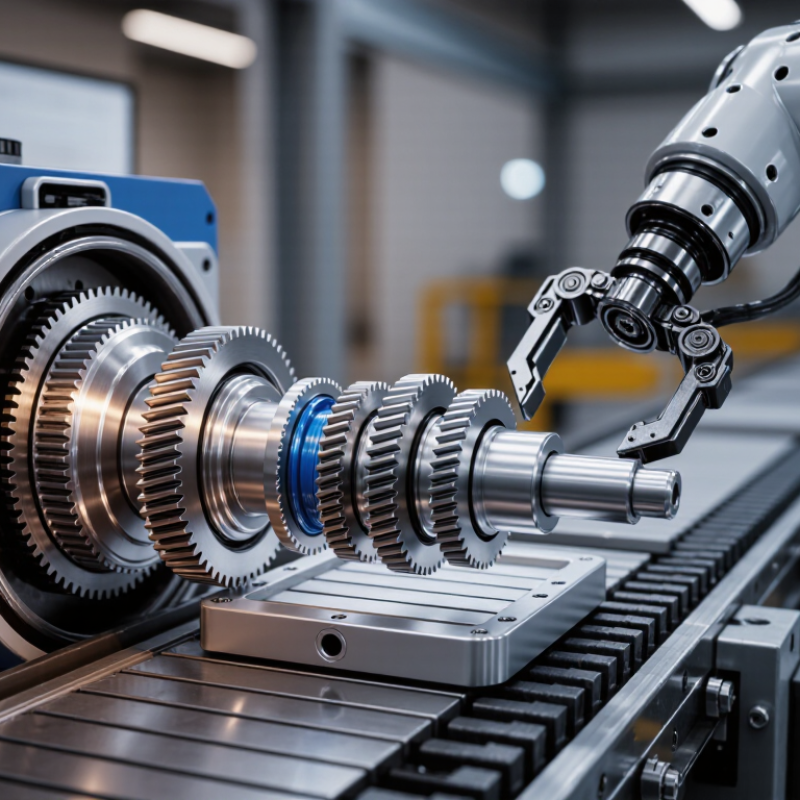
Why Are Robotic Gears Essential for Automation?

What Robotic Gears Are and How They Work

Robotic gears transfer motion from a motor to a robot joint. They can reduce speed while increasing available torque, helping an arm lift a load or hold a tool steady. A gear train uses toothed wheels that mesh; the tooth count and arrangement determine how rotation changes. In a simple pair, a small driving gear turns a larger gear more slowly, with greater output torque. Real performance also depends on friction, load, lubrication, and the motor.

A gearbox packages these gears into a compact unit. Spur gears use straight teeth and are relatively simple, while planetary gears arrange several smaller gears around a central gear. This layout can deliver high torque in limited space. Some precision joints use strain-wave gearing, which can provide a large reduction, though it may be sensitive to wear and loading. Each design has trade-offs.

The connection matters. Gear backlash, the small clearance between meshing teeth, can cause a joint to move slightly before the output responds. Small errors grow. In a robot gripping a fragile cup, that delay can affect placement; in a heavy arm, heat and gear wear may matter more. Engineers match gear ratio, stiffness, size, and expected duty cycle to the task. One detail is easy to underestimate: a high reduction ratio does not automatically make a robot more accurate. The complete drive system and its control settings matter too.

A gearbox trades rotational speed for torque. In an ideal gear train, a 5:1 ratio multiplies input torque by 5, while reducing output speed to one-fifth. Real gearboxes deliver less torque because of friction and other losses. This torque multiplication helps robots move loads and control motion precisely.

How Gears Transfer Motion and Multiply Torque

In an automated cell, a robot’s motor may spin quickly, yet its gripper needs controlled force, not speed alone. Gears connect those different demands. A reduction gearbox uses smaller input gears to turn a larger output gear, lowering speed while increasing torque. The trade-off is real: friction and heat consume some energy. Nothing is free.

That exchange matters on a factory floor. A robot arm lifting a metal part needs enough torque to hold it steady, then move it without shaking. Gear ratios help match motor output to each joint’s load and speed. In 2023, 541,302 industrial robots were installed worldwide, according to the International Federation of Robotics’ World Robotics 2024 report. More robots mean more motion to control, though the report does not isolate the role of gearing.

Gear design also affects positioning accuracy and service life. Backlash—the small clearance between gear teeth—can create tiny errors at a robot’s end effector. Too little clearance can raise friction; too much can make movement feel loose. Engineers therefore balance torque, precision, heat, and maintenance needs for each task. It is an imperfect balance. A gearbox that performs well in a clean laboratory may behave differently after years of dust, vibration, and repeated starts.

Why Precision Gearing Matters in Automated Systems

Precision gearing helps an automated system move accurately, repeatedly, and with predictable force. In a robot joint, a small backlash can shift the gripper’s position after a change in direction. That shift may be minor on a drawing but noticeable when placing a component into a narrow fixture. Small errors matter.

Gears also shape the trade-off between speed and torque. A reduction stage can give a motor more usable output force, while its tooth geometry and stiffness affect how consistently that force reaches the load. During repeated pick-and-place cycles, poor alignment or uneven tooth contact can create vibration, noise, and extra wear. The result may be less reliable motion, even when the controller is well tuned.

Precision depends on more than the gear itself. Mounting accuracy, lubrication, temperature, and changing loads all influence performance. A gearbox that feels smooth during a cool test may behave differently after hours of operation. Not always. This is why engineers measure backlash and repeatability under realistic conditions, rather than relying only on catalog figures. Even careful specifications cannot remove every source of error; that is worth remembering when a system misses its target by only a fraction.

Why Are Robotic Gears Essential for Automation? — Why Precision Gearing Matters in Automated Systems

Gear Type How It Transmits Motion Relevant Precision Characteristics Advantages in Automation Trade-Offs Typical Robotic Use
Spur gear Straight teeth transfer rotation between parallel shafts. Backlash, tooth accuracy, shaft alignment, and bearing clearance affect positioning repeatability. Simple construction, high efficiency, and straightforward inspection and maintenance. Can be noisy at high speed; tooth engagement may cause vibration and impact loading. Compact mechanisms, simple rotary axes, feeders, and low-cost positioning devices.
Helical gear Angled teeth engage progressively between parallel or crossed shafts. Tooth contact quality and control of axial movement influence smoothness and positioning consistency. Smoother, quieter operation than comparable straight-tooth gearing; suitable for continuous motion. Creates axial forces that require suitable bearings; sliding contact can increase heat and friction. Robot joints and automated drives where smooth motion and reduced noise are important.
Planetary gearhead Several planet gears rotate around a central sun gear inside a ring gear. Backlash, torsional stiffness, load sharing, and assembly tolerances affect accuracy under load. Coaxial, compact design with high torque capacity relative to its size. Precision and service life depend on component quality, lubrication, and correct loading. Servo-driven robot axes, mobile robots, and compact automation equipment.
Strain-wave gear A flexible spline is deformed by a wave generator to produce a large reduction in a compact assembly. Low backlash is possible; torsional stiffness, elastic deformation, and hysteresis still affect loaded accuracy. High reduction in a small, lightweight package; useful where compact joint design matters. Efficiency and heat generation vary with speed, load, and design; the flexible element is subject to fatigue. Compact articulated robot joints and other space-constrained precision axes.
Cycloidal gearhead An eccentric input drives a cycloidal disc against pins or rollers to create reduced output rotation. Output accuracy depends on manufacturing tolerances, bearing condition, backlash, and elastic deflection. Can withstand substantial shock loads and offers a compact reduction mechanism. May produce more vibration or noise than smoother gear arrangements, depending on design and speed. Industrial robot joints and machinery exposed to demanding loads or occasional impacts.
Worm gear A screw-shaped worm drives a meshing wheel, typically between shafts at right angles. Backlash, friction, temperature, and wear influence positioning and long-term repeatability. Provides substantial speed reduction in a compact layout; some designs resist back-driving. Sliding contact can reduce efficiency and generate heat; lubrication and thermal management are important. Rotary positioning units, adjustment mechanisms, and selected low-speed automation axes.

Engineering note: Gear type alone does not determine system precision. Achievable accuracy and repeatability also depend on backlash, stiffness, encoder placement and resolution, motor control, mounting, payload, temperature, and wear.

Common Gear Types Used in Industrial Robots

Industrial robots use different gear types because each joint faces a different mix of speed, load, and accuracy demands. A reducer lowers motor speed and increases torque. Harmonic, cycloidal, and planetary gears are common choices.

Harmonic drives fit compact wrist joints, where low backlash and high reduction ratios help control precise movements. Their flexible spline, however, can fatigue under repeated stress.

Cycloidal reducers suit heavily loaded axes and tolerate shock well, but may add weight and vibration. Planetary gears offer a compact, efficient option for many servo-driven joints.

Not interchangeable.

The scale of deployment makes these trade-offs important.

IFR’s World Robotics 2024 report recorded 541,302 industrial robots installed worldwide in 2023, with 4,281,585 operating globally.

Those figures describe robots, not gearbox demand, but they show how widely joint components are used. In practice, engineers also check thermal behavior, mounting stiffness, lubrication, and duty cycle—not just rated torque. A reducer that looks ideal on paper can perform poorly if alignment is off or heat builds up.

The selection is rarely tidy. For a fast wrist, low backlash may matter most; for a shoulder joint lifting a heavy part, shock capacity and service life can take priority.

How Gear Selection Affects Robotic Performance

Robotic gears influence how accurately a machine moves, how much load it can handle, and how quickly it responds. A high reduction ratio can increase output torque, but it may also limit speed and add backlash. That lost motion matters when a robot must place a small component precisely. For a heavy arm, a compact gear set may save space, yet heat and wear can rise under repeated loads. The best choice depends on the task, not just the motor’s advertised power.

Tips: Match the gear ratio to the payload and movement speed. Check backlash, rated torque, duty cycle, and lubrication needs. If the robot reverses direction often, test for lost motion under realistic loads.

Selection involves trade-offs. Planetary gears can offer high torque in a compact package, while harmonic drives can provide low backlash for precise positioning. Neither is automatically ideal. A gear that performs well in a slow pick-and-place cycle may struggle with rapid starts and stops. Measure temperature and positioning error during a representative test, then compare results with the application’s requirements. Small details matter: cable drag, mounting stiffness, and uneven payloads can all affect motion. Estimates help, but actual testing may reveal an inconvenient mismatch.

Article Source: